Showing posts with label Rafael Nadal. Show all posts
Showing posts with label Rafael Nadal. Show all posts
Tuesday, February 7, 2012
Djokovic-Nadal: Was it Really That Good?
===
"A new definition of suffering," was the way that ESPN's Chris Fowler summed up the 5-hour and fifty-three-minute 2012 Australian Open final between Novak Djokovic and Rafael Nadal that was part horror flick, part torture chamber, and part epic.
Some anointed the final as the "greatest ever" just minutes after Djokovic ripped his shirt off and flexed his sinewy muscles for all the world to see. Others, like me, demurred. Oh, yeah, the tennis was brilliant for spells, and the tension and drama was enough to make your skin crawl (we tennis fans love that, don't we?), but the match was also sloppy at times (according to stats 38% of points ended in unforced errors, compared to 24% and 21% in their previous two Grand Slam finals), and as much as the robotic level of fitness elevated the collective opinion of what had transpired between Djokovic and Nadal, the sheer physicality of their battle also functioned as an anchor, pulling the level of tennis down with each passing hour.
The question that kept popping into my head as I watched the fourth and fifth sets transpire was: do we really want tennis to be like this?
To elaborate: Do we really want six-hour finals? Do we really want fitness to be a larger and larger part of the eventual outcome of Grand Slam events? Are the longest matches really the best matches? Are slower surfaces, co-poly strings, heavier balls, and ridiculously fit athletes dumbing down the sport?
If I sound negative, I don't mean to. I'm as invested in the modern era of tennis as the next guy -- and I'm as impressed with the tennis that Djokovic and Nadal played in the Australian Open final as the next wide-eyed enthusiast. Was I blown away? Sure. Hell yeah. But I also found myself longing for more diversity, more improvisation, more brevity.
I'll admit: I'm old-school and I worry about things. I dread the disappearance of the one-handed backhand, but the way that the modern topspinners can expose such players, it seems like the shot will eventually be nothing but a memory. I also dread the thought of full tennis matches where neither player hits an approach shot and comes to the net to knock off a volley winner. Solid net play still happens today, but less than ever before. You can't blame the players. Guys are just too good at passing nowadays.
But I digress. I'll stick to the script here and tell you how I really feel: I don't want to see Grand Slam finals where the outcome is decided by which player can endure the most suffering and keep his game together just enough to get him through. I don't want to see tennis become more like a triathlon or a Tour de France, and less like the succinct, artistic endeavor that it is supposed to be.
When our greatest match is also the most torturous, there's something wrong in my opinion. When elegance and precision is replaced by brute force, repetition and 40-second rests between points, we are headed in the wrong direction.
I'll not deny that Djokovic and Nadal's work of stunning and brutal combustion in the 2012 Australian Open final was one of the most remarkable Grand Slam finals I've ever seen. And yes, it has to be placed up there among the best in history, based on its pugilistic element and the suspense.
But to call this battle of attrition the best Grand Slam final of all-time would be, in my humble opinion, myopic.
Longest, yes. But best? I'm not so sure.


Sunday, January 15, 2012
Quotable Quips: This Week in Tennis Quotes
===
Welcome to Quotable Quips, where we scour the internet, the pressers, the match recaps, and whatever else we can get our hands on to get a handle on who said what, why who said what, and what who might have meant when who said what.
“I am always surprised to see professional players searching for former professional players in order to solve issues that are linked to coaching. When Lendl was facing up to his four failures in Grand Slam finals, he called Tony Roche and their collaboration changed his career. Therefore learning from the Lendl situation does not mean Murray should call Lendl - but rather someone like Roche himself. The man is the most successful coach in the world, with 14 Grand Slams achieved with three different players.” --
Patrick Moratoglou, in this Yahoo piece.
Bonus: Rafa Three-pack:
“For a few balls, for the higher balls, you can hit the ball, you know, with a little bit more flat because the racquet goes faster into the ball. The racquet goes quicker.” --
Rafael Nadal on his racquet, which is three grams heavier, with the weight added to the head.
“I give information for you to write newspapers. But at the end of the day I look like I am the one who always talk about things that must change, and I don’t win nothing on that. I just lose time, energy, and the people can think that he’s always the one who says the bad things, the negative things."
-- on his leadership role among players and with the press.
“I didn't say that I lost motivation to play tennis. I say that I played a few matches at the end of last year with less passion than usual - not saying that I am not any more motivated to play tennis.” -- on his perceived lack of passion for the game.
“I try not to bore people with silly things like match results. Because, really — who cares about them?”
-- Laura Robson, as quoted in a New York Times Straight Sets piece.
"Isn't that the Petko dance?" -- Corina Morariu, responding to close-up camera footage of a prehistoric-looking bug that was on the court in Sydney between points of the Na Li Victoria Azarenka final.
“I think Ivan can help him understand how important body language is. That’s one of the four reasons why Andy hasn’t won yet. Federer, Nadal and Djokovic being the other three.” -- Mats Wilander, in an email to New York Time’s correspondent Chris Clarey.
“Who knows if this will last six months or six years, but I’m confident that at the end of this that Andy is going to come out a better player for the experience.” -- Darren Cahill, quoted in the same piece by Christopher Clarey.
"Yeah, I know I can beat anybody. I've beaten the best before." -- Aussie fan favorite Marcos Baghdatis, after defeating Juan Martin Del Potro in Sydney.
''I laugh a lot, so I think that has a lot to do with developing those muscles. I don't really do sit-ups too much.'' -- Serena Williams, on her oft-photographed six-pack.
''Margaret has said her feelings and it's public and it has leverage so I think this is the only way the people feel that they can be heard - through a sign of solidarity. As long as it is done tastefully, that's the most important thing for me.'' -- Rennae Stubbs, on the prospect of protestors turning out to rally against Margaret Court’s anti-gay marriage statements.
My Lebanese food from my grandma makes me feel good.'' -- Marcos Baghdatis, on why he feels Australia is so good to him.
“After that I went home, procrastinated on the packing for the earlier than expected trip to Melbourne, and got some rest. I awoke to all the media coverage of the loss and I can assure you it looked more dramatic than it was.”
-- Samantha Stosur, in her own words, as published in this piece.
Tuesday, December 13, 2011
"Rafa" The Book: Understanding Uncle Toni's Profound Influence
 I've spent the last few days curling up with Rafa's recently published book "Rafa," by Rafa himself and writer John Carlin. It's been a surprisingly entertaining read about one of the most compelling personalities of the sport, and I must say, it has only made me appreciate all of Rafa's remarkable character traits even more.
 There are a lot of topics discussed in the book, but for me the most interesting and eye-opening content concerns Rafa's unique relationship with Uncle Toni and Rafa's symbiotic relationship with the rest of his family.
I'll focus on Uncle Toni in this post, because I felt that the book was particularly revealing in that regard, and, anybody who hasn't read the book might not fully understand or appreciate just how significant the bond that Rafa and Uncle Toni share is.
First, I was struck by the similarities between Rafa's relationship with Uncle Toni and Andre Agassi's relationship with his father Mike. There are certainly differences, but the similarities struck me immediately. Like Mike Agassi, Uncle Toni believes in discipline; more specifically, in making practice almost unbearably difficult, so that tennis matches would seem comparatively easy.
"Yes, he might have gone too far, but it's worked very well for me," says Rafa of his Uncle in the book. "All that tension in every single coaching session, right from the very start, has allowed me today to face up to the difficult moments in a match with more self-control than might otherwise have been the case. Toni did a lot to build that fighting character people say they see in me on the court."
While Agassi developed a keen sense of contempt for his father, Nadal, due to the strength of his family life (which provided him with balance and joy, and kept him from getting too tightly wound) and perhaps his docile nature, never rebelled against Toni. "By pushing me always to the edge, he built up my mental strength," said Rafa. "But the intensity of his desire for me to triumph was complemented in a healthy way by my father's relaxed attitude to the whole thing."
The book certainly raises questions about the best way to build a tennis champion. Families such as the Williamses, the Agassi's and the Nadal's have used familial relationships to bend the rules of discipline and to push the coach-player dynamic beyond acceptable societal limits. In doing so the relative/coach gains entry into the deepest parts of their pupil's psyche, which allows them to push buttons that other coaches with less access might never get to push.
The player-coach dynamic wasn't always so simple for Nadal, and Toni's role in Rafa's tennis did not always go unquestioned. "Toni was hard on Rafa because he knew Rafa could take it and would eventually thrive. He would not have applied the same principles, he insists, with a weaker child," wrote John Carlin in the book. "This argument prevailed in the family at least to the point that no one, not even Rafa's mother, ever really confronted Toni and told him to ease up on the child. They understood that spending so many hours and hours with Toni was wearing in the extreme, but that the two of them had reached a point where they could not live, much less succeed in tennis, without each other."
It wasn't always pretty, but Toni, strong-minded ex-tennis player that he was, had his plan. More importantly, he had the families' support when it came to Rafa's tennis, even when things got awkward, as they did quite often.
When Rafa was 12, he returned home from an important victory in South Africa to a big party at his Grandparent's house. But before he could begin to celebrate, he was ushered away by Uncle Toni, who then said to the Grandmother: "What are you trying to do to Rafael? You'll ruin him. Don't give what he does so much importance."
Another example, from Rafa's 11th year, is also telling. After winning the Spanish under-12's, Toni took the initiative to phone the press to get the list of the previous twenty-five winners of the tournament. "Then, in front of the rest of the family, he read out the names and asked me if I had ever heard of any of them," writes Rafa. "'So and so, do you know him? No. This guy? No. And this one? No.' There were just five who had reached a decent level as professionals, whose names meant something to me. Toni was triumphant. 'You see? The chances of you making it as a pro are one in five. So, Rafael, don't get too excited about today's victory. There's still a long, hard road ahead. And it all depends on you.'"
Toni's influence over Rafa, and his ability to motivate him, has not wavered over the years. Even now, his words are what motivates Rafa to never be satisfied with himself, to always be humble, and to keep sharpening his mental focus in order to defeat opponents who are believed to be more naturally gifted than he is.
"Whether he's made me a better player, or I him," writes Nadal, of his rival Roger Federer, "it's hard for me to say. Toni has never ceased to remind me -- and I know he is right -- that Federer is more technically gifted than I am, but he does so not to cause me despondency, but because he knows saying so will motivate me to sharpen my game. I watch Federer playing on video sometimes, and I'll be amazed at how good he is; surprised that I have been able to beat him."
Tennis fans have always known that Rafa and Uncle Toni shared a special bond. After reading "Rafa," we now know some of the quirkier details of the union. John Carlin aptly calls them the "Dynamic Duo,", and the compelling book that he has co-authored with Nadal pays heed to their unique relationship, and the undeniably important role it has played in Rafa's success on the ATP Tour.
Friday, November 25, 2011
The Deuce Court: Is Nole's Season Diminished By London?
===
Today The Deuce Court will discuss the merits of Novak Djokovic's 2011 season, even though it isn't technically over yet.
Deuce #1: So, How Good Was His Season?
Djokovic was as succinct as could be after losing in three sets to Janko Tipsarevic today, when asked about what was missing from his game in London by a member of the media: "Freshness," was his reply, and the word spoke volumes. Of course, in tennis, there are no excuses for losing. As a result, Djokovic will have to face the fact that his mind-bending 2011 season will forever be tainted in the eyes of those special few who decide which player had the "Best Season Ever," due to this lack of freshness. How much will it be tainted? Not much at all. But, enough to place him below John McEnroe in 1984 and Roger Federer in 2006, most likely.
Deuce #2: Not So Fast
Personally, I'm not so quick to write off Djokovic's accomplishments. Look, he was running on empty in London, and that has to be taken into account. But placing too much emphasis on two uninspired matches would be a mistake, especially given the sheer brilliance of Djokovic's Grand Slam season. Novak may tap out at 70 wins and 6 losses, leaving him with a decidedly lower winning percentage than McEnroe's 96 % or Federer's 95%, but can either Federer or McEnroe say that they disrupted the most legendary duopoly in the history of the sport during their critically acclaimed seasons?
There is an element of transformation to Djokovic's ascent that makes his season even more remarkable. Who could have predicted, before the year started, that we'd be looking at a sport with a Serbian No. 1, a player who had been cast off by so many as an underachiever, as one who'd never be able to overcome his physical limitations or the otherworldliness of Federer and Nadal?
Ad In: Fine, Have it Your Way
I'm not trying to argue that we should give Djokovic a pass for not finishing his season with a flourish. But I will argue that you should take into account the following things: 1) The sheer physicality of the game is astounding these days, so it's no surprise that Djokovic played some flat tennis in London (see Nadal, Murray...) and 2) the depth of the men's field is perhaps as strong as we've ever seen it. So, if you're going to dock Djokovic's 2011 body of work for his London letdown, you should also take into the account the very tangible reasons for the lack of "freshness" that he experienced (namely, that he played off-the-wall highly inspired tennis for 9 months).
Deuce #3: It's not quite over
As I write this, David Ferrer and Tomas Berdych are warming up for the last round-robin tilt of the week. If Ferrer wins, Djokovic will face Federer in the semis. Will naysayers have a change of heart if Nole somehow rallies to take the title?
Ad Out: Summing it Up
Regardless of where Djokovic's season stands on the all-time list, it's pretty clear that the fact that we have been debating the merits of his season since early spring means that something UTTERLY AMAZING has been achieved by Djokovic in 2011. When you put everything into perspective and consider how far he had to climb, who he had to defeat and how often (6 finals over Nadal? Are you serious?) and what kind of style and verve he did it with (the match point miracle in New York? Are you serious?) you pretty much have to bow down and show respect, regardless of how his less-than-devastating performance in London might lead to criticism from the pundits.
Finally, when we think about how Djokovic's season stacks up, I think it's a good idea to realize that numbers, while telling, aren't the only way to measure a season. Can a 70-win season with six losses be as good as an 82-win season with three losses, or a 92-win season with five losses? Sure.
Now that so many are now secure in the notion that Djokovic's season, because of his performance in London, cannot be considered the best season ever, the precedent has been set. Djokovic's season, at least the way it will be perceived in the future, has dropped a notch.
I'm not so sure that's a proper thing, nor am I sure that it's warranted. I'm not a betting man, but if I was, I'd be betting that tennis doesn't see another season as remarkable as Djokovic's in the next 30 years, maybe more.
Monday, November 21, 2011
Second Serving: Day 1 WTF's: Federer Loves Indoor Courts and More
===
Editors Note: From this point forward, The Fan Child will refer to the Barclays ATP World Tour Finals as the "WTF's." Please take note.
Now, let us dissect day 1...
Rafa? Roger? Anybody? Beuller?
Was it just me, or did it seem like everybody had a difficult time maintaining an elite level today. Roger was guiding the ball rather than driving it. Rafa's forehand was too round, and his slice was too fluffy. Jo-Wilfried was asleep for the first 30 minutes. Fish was good at times, but his forehand lost its will at others.
In other words, it wasn't necessarily pretty...
Let's Talk About Day 2 Then:
Murray-Ferrer and Djokovic-Berdych are on tap for Monday. Here are some stats/ analysis:
Murray leads Ferrer 5-0 on hard courts, but let's not forget how tough Ferrer played Muzz in their biggest match of 2011. Ferrer won the first set and also pushed Murray to second and fourth set tiebreakers in their Australian Open semifinal match.
Djokovic on His Shoulder:
"I have been serving almost 100 percent the last two or three days," said Novak. "So for me the shoulder is fine at this moment." My worry: Almost 100 percent? I'm not sure that's such thrilling news...
Tracking Back to Noah's PED rant:
Read about it: Rafa's reaction, Uncle Toni and Ferrer were quoted in this Telegraph Piece.
Fed With Gimel:
On Sunday, Tennis Channel aired Fed's interview with Justin Gimelstob on the practice courts (filmed at least a day before his first match). Federer expressed minor concerns about the speed of the London courts. "I think conditions are a bit faster here. I'm still struggling a little out here a bit actually, so that's a little bit of a slight worry, but I still have another day to prepare," said the five-time WTF titlist. "The thing with Tsonga, and with Fish -- because he's also in my group -- is they can sort of hit you off the court."
Fed also said that indoors are a great love of his: "This is where I did the breakthrough, back in '98 actually. I went to the quarters of Toulouse, and then the year after that I had the breakthrough beating Moya, who was world No. 4. So I think indoors has always been sort of my first love on tour."
Doubles?
You want dubs? We got your dubs...
Both doubles tilts went to Match Tiebreaks today, and both ended 11-9. The Indo-Pak express had the balls to serve, up 6-3 vs. Nestor and Myrni, but still lost. One of the teams I know the least about, Fyrstenberg and Matkowski (Who? The ATP website is calling them 'Polish Power') pulled a big upset against Zimonjic and Llodra in the other 11-9 Match Tiebreak.
On Monday, The No. 1 Bryan Bros. will battle Jurgen Melzer and Philipp Petzschner. Incidentally, the Bryans own a 4-0 vs. MelPetz. Mahesh Bhupathi and Leander Paes will face Robert Lindstedt and Horia Tecau for the first time in the other round-robin tilt.
The O2 Arena: an awesome tennis venue:
Check out this photo of the 02 Arena ready for tennis. The court looks like an oasis of light. This is rock-n-roll tennis, baby. Let's hope the players follow suit tomorrow...

Saturday, November 19, 2011
The Deuce Court: Noah Gone Wild, Rafa's Chances
===
Welcome to The Deuce Court, where we wax poetic about tennis while keeping it sweet and short...
Deuce #1: Really, Yannick?
Most of you know by now that France's last Grand Slam champion penned some scathing commentary about Spanish sports having "la potion magique" while other nations like France are too strict and law-abiding to enjoy the benefits of PED's. As is always the case with these type of allegations, Noah's unfounded accusations are at best irresponsible, at worst harmful, Whether Noah intended to do it or not, he has unfairly cast the Spanish players in a very negative light.
The whole piece smacks of a bitterness that I never suspected a person as happy-go-lucky as Noah to possess, but the craziest ideas of all came in the last line: Noah wrote "La meilleure attitude à adopter est d'accepter le dopage. Et tout le monde aura la potion magique." which roughly translates to "The best attitude to take is to accept the doping, then everybody will have the magic potion." This is wrong on so many levels. So, we are just supposed to ban all attempts to curb doping because some athletes in some less-policed nations are allegedly gaming the system and gaining an illicit advantage? Great, and while we're at it, let's make sure that the 6-12-year-old's are getting there share of dope as well.
No, no, no. Not good at all. As messy and expensive as policing doping is, and as unfair as it may or may not be (because there will always be some who have found "la potion magique" and, more importantly, found a way to avoid detection), just giving up the chase entirely will never be the solution. There are lives in the balance Yannick, not just wins and losses -- get with the program.
Deuce #2: Tipping Rafa
It's been a month since Rafa's disappointing loss to Florian Mayer in Shanghai, so it's somewhat of a mystery as to what form he'll actually be in when the Barclays ATP World Tour Finals begin. Based on what I've seen from his practice vids, and what he's telling the press in this piece, Rafa basically pulled the plug on playing in Asia because he wanted to go home, regroup, and come back with a renewed focus for this event and for the upcoming Davis Cup final with Argentina. We all know what Rafa can do when he sets his mind to something. I think more than anyone else in the field, Rafa wants this title. Because of that, he's my pick to win it. That could change after I see his form, but for now, I'm tipping Rafa to do the deal in London.
Ad In: Less than 24 hours to go until the #finalsshowdown begins in London.
What a fantastic way to finish the season. As Federer said (paraphrasing) in a pre-tourney media interview, opening a tournament against a top ten players really gets your blood pumping. Mine too. No offense to the rest of the top 100, but how nice is it to get all this talent bundled up into one delectable holiday package, at the perfect venue, with throngs of tennis hungry fans, and no chance of an early round upset? And even better, if your favorite player loses his first match, he's still got two more to play. No offense to Shanghai, Houston, or anyplace else, but since the finals moved to London, I have been all-in. I sense that I am not alone in this sentiment.
Deuce #3: Tsonga Not Intimidated
Good luck to the rest of the field trying to top this quote. He may not win the event, but the Frenchman has best quote wrapped up.
Ad Out: Helfant's replacement
Christopher Clarey's must-read on the future of tennis looks at the search for a new Chief Executive, possible changes to the rankings systems and more.
Tuesday, November 15, 2011
ATP World Tour Finals: Federer, Nadal Set to Meet

===
Roger Federer and Rafael Nadal will renew their storied rivalry next week in London, as the two were drawn into Group B alongside Jo-Wilfried Tsonga and Mardy Fish. Below are all the singles and doubles group pairings.
Federer is attempting to become the first player to win the event for a sixth time. The 2010 champ is currently tied with Pete Sampras and Ivan Lendl, who have each won the title five times.
Nadal leads Federer in their head-to-head rivalry 17-8, and he won all three matches that the pair contested in 2011, losing only one of the eight sets they contested.
World No. 1 Novak Djokovic is seeking a second World Tour Finals title to top off one of the most successful seasons in ATP history. He will contest Group A, along with Andy Murray, David Ferrer and Tomas Berdych,
Play begins on Sunday, with 2 singles and 2 doubles matches taking place. Stay tuned for previews and analysis later in the week.

Monday, September 19, 2011
From Out of the Ashes, A Final to Die For
The valiant efforts of the world's top players during Davis Cup play over the weekend reminds us that the event is about more than just tennis.
===
Pity on me, for I spent most of the Davis Cup weekend wondering why the heck Rafael Nadal and Novak Djokovic were subjecting themselves to the rigors of the Davis Cup semifinals when they should have been spending the week shuttling between the Hyperbaric chamber and the massage table. After the torturous final week of the US Open, I had convinced myself that the worst thing for the game -- and subsequently, the worst thing for the game's top two players -- would be to see these guys take the court for their countries less than a week after the US Open's Monday final.
The fact that Nadal and Djokovic were willing to lay their bodies on the line for their countries this weekend -- as much as it pained us to watch -- has once again opened my eyes to the allure of Davis Cup. It's about tennis, but also it's about something bigger. In the end, I realized that I have no business questioning Serbia's move to play Novak Djokovic on Sunday, even though he was only at 60%. They wanted the win, and they were prepared to risk it all to get it. Who can fault them for that?
Additionally, the Davis Cup finally got a dose of the starpower it has been yearning for so badly, with Federer showing up in Australia and Andy Murray getting busy against Hungary.
All things considered, it was a fantastic weekend for Davis Cup, in which the true spirit of the event came through. My initial reaction was to reject it, but in the end, it won me over. With Argentina set to clash with Spain in the final in December, the tennis cognoscenti are already wondering if a bit of Davis Cup glory might do for Juan Martin del Potro what many believe it did for Novak Djokovic after Serbia's victory in 2010.
===
Pity on me, for I spent most of the Davis Cup weekend wondering why the heck Rafael Nadal and Novak Djokovic were subjecting themselves to the rigors of the Davis Cup semifinals when they should have been spending the week shuttling between the Hyperbaric chamber and the massage table. After the torturous final week of the US Open, I had convinced myself that the worst thing for the game -- and subsequently, the worst thing for the game's top two players -- would be to see these guys take the court for their countries less than a week after the US Open's Monday final.
In this age of brutally physical tennis, where players are considered over the hill at the age of 30 (well, not all of them, but most), I was worried that Djokovic and Nadal were taking on too much of a burden to play Davis Cup. This is how careers get shortened, I was thinking, already lamenting the day that each will declare themselves through with the game (when none of us are quite through with watching them play the game).
Even as it had to be therapeutic for Nadal to lead his fellow Spaniards to victory on home soil against France, I kept finding myself asking "Why the heck is he playing?" In the end, Rafa probably made the right decision to play. He did it for the fans and for his teammates, and down the road, he'll be remembered for acts like this where his humility and dedication to country take center stage right along with his otherwordly brand of clay court tennis.
But even after Nadal sealed Spain's 4-1 victory with an awe-inspiring thrashing of Jo-Wilfried Tsonga, you could tell he wasn't happy that he had to do it with the fatigue of four matches in five days still weighing heavily on his bones. Such is the quandary that Davis Cup presents.
To play or not to play? To care or not to care? To sacrifice the body or preserve it?
Given that the event can be such a momentum-grower, it was hard for me to understand why the Spanish team didn't try to grow some momentum for some of their players who need it the most. Why not give Fernando Verdasco a chance to get the inspiring win he so badly needs at the moment? (Verdasco did beat Gasquet in a meaningless dead rubber to close the festivities.) We're talking about a wonderfully talented Spanish team that is built not just on one man after all.
I know in hindsight Rafa's triumph was what the fans wanted, what the team wanted (it sets up a mouth watering final vs. Argentina in December) and maybe even what Rafa wanted, but it would have been nice if someone else had been given a shot to shine. Especially since Rafa could have used the rest, and his comrades could have used the confidence that might have come if they had beaten the French without him.
In Belgrade, Serbia suffered exactly what Spain avoided. Novak Djokovic was sent to the court running on fumes, and he paid dearly for it when he faced an inspired Juan Martin del Potro. Djokovic's retirement gave Argentina the victory, and it puts the Argentines in position to win their first Davis Cup title in Spain in December.
Given that the event can be such a momentum-grower, it was hard for me to understand why the Spanish team didn't try to grow some momentum for some of their players who need it the most. Why not give Fernando Verdasco a chance to get the inspiring win he so badly needs at the moment? (Verdasco did beat Gasquet in a meaningless dead rubber to close the festivities.) We're talking about a wonderfully talented Spanish team that is built not just on one man after all.
I know in hindsight Rafa's triumph was what the fans wanted, what the team wanted (it sets up a mouth watering final vs. Argentina in December) and maybe even what Rafa wanted, but it would have been nice if someone else had been given a shot to shine. Especially since Rafa could have used the rest, and his comrades could have used the confidence that might have come if they had beaten the French without him.
In Belgrade, Serbia suffered exactly what Spain avoided. Novak Djokovic was sent to the court running on fumes, and he paid dearly for it when he faced an inspired Juan Martin del Potro. Djokovic's retirement gave Argentina the victory, and it puts the Argentines in position to win their first Davis Cup title in Spain in December.
The decision to send an already injured and energy-depleted Djokovic on court against Del Potro was a head-scratcher for sure. The pressure to put Nole out there on the final day must have been great -- and coming from everywhere. Still, the man had a torn rib muscle -- why run the risk of doing serious damage to it?
Here's a better question: Why ask why?
In the end, Djokovic and Nadal's valiant efforts, regardless of the outcome, shines a light on Davis Cup and points to it's uniqueness and validity as an event. The event has been much maligned due to its inconvenient placement on the tennis calendar, but regardless of its knack for bad timing, or its relatively meager compensation levels, the event is major source of pride for for all who partake.
The fact that Nadal and Djokovic were willing to lay their bodies on the line for their countries this weekend -- as much as it pained us to watch -- has once again opened my eyes to the allure of Davis Cup. It's about tennis, but also it's about something bigger. In the end, I realized that I have no business questioning Serbia's move to play Novak Djokovic on Sunday, even though he was only at 60%. They wanted the win, and they were prepared to risk it all to get it. Who can fault them for that?
Additionally, the Davis Cup finally got a dose of the starpower it has been yearning for so badly, with Federer showing up in Australia and Andy Murray getting busy against Hungary.
All things considered, it was a fantastic weekend for Davis Cup, in which the true spirit of the event came through. My initial reaction was to reject it, but in the end, it won me over. With Argentina set to clash with Spain in the final in December, the tennis cognoscenti are already wondering if a bit of Davis Cup glory might do for Juan Martin del Potro what many believe it did for Novak Djokovic after Serbia's victory in 2010.
In a sport that is highly individualistic, we owe it to Davis Cup for providing a platform for fans to see the world's top players in another element. Even when things go horribly wrong, like they did for Novak Djokovic and Serbia in Belgrade, we learn something new about the character of the players in the process.
I can't complain about that at all.
Tuesday, September 13, 2011
Djokovic, Nadal, Chess and Pugilism
===
Chess and pugilism were two words that kept coming to mind as I watched Novak Djokovic and Rafael Nadal trade mammoth blows in yesterday's US Open final. Chess, because each shot in a rally represented a minuscule step in a sequence that, if played with clairvoyance, would ultimately lead to an opportunity to gain an advantage in the point.
Yesterday the message was clear, as Djokovic and Nadal blanketed the court with alarming ease: This is not your mommy and daddy's tennis anymore.
At the elite level, today's tennis takes more patience, and consequently, more mental and physical prowess than ever before. A,B,C tennis has given way to a more sophisticated endeavor. What starts as chess morphs into boxing -- pure blow-by-blow brawling -- and back again, often several times before any given point can be won.
Yesterday, on Arthur Ashe Stadium, I believe we witnessed the tennis as a hybrid of boxing and chess metaphor more clearly than ever before. It was the writing of David Foster Wallace that first introduced me to the concept that tennis could be viewed as similar to boxing. I'll be honest and admit that I never fully grasped the boxing analogy -- until yesterday.
During Novak Djokovic's 6-2, 6-4. 6-7, 6-1 victory over Rafael Nadal, the tennis was so brutally physical, the points so long and the intensity so high, that it could only be viewed as combat. It was Road Warrior tennis, the tennis of the future, and as I watched these two gladiatorial antagonists look for ways to grind each other to the brink of exhaustion while simultaneously seeking whisker-thin opportunities to gain an upper hand, I couldn't help but be mesmerized.
It wasn't necessarily beautiful. It wasn't necessarily poetic. But man, was it eye-opening; it was limitless and scary, too.
There was a titanic struggle for the 3rd game of the second set that was difficult to watch. Finally, Djokovic won the game on his sixth break point, but not after 6 lung piercing rallies of 14 strokes or more, including back breaking rallies of 27, 21 and 21 strokes.
This was probably the turning point of the match for Djokovic, and not simply because he'd broken to get back on serve in the set. He'd also proved that he was ready, willing and able to beat Nadal at the very game that he has used to beat everybody else on tour for the last few years.
While Djokovic and Nadal are both fantastic at this tennis as a hybrid of boxing and chess thing, it was Djokovic who proved himself to be the true savant, because while Nadal appeared to be playing the same brand of swashbuckling tennis he always plays yesterday (and doing it quite well, mind you), Djokovic was far better at customizing his brand of chess to suit the vulnerabilities of Nadal.
Each shot that Djokovic hit had purpose. Like a true chess champion, Djokovic thinks not just of the next shot; he thinks of the next several, and where those might lead him. But he doesn't only think ahead. In the heat of the moment he executes each step in his multi-pronged movements with precision. He hits to Nadal's backhand not because he wants to get an error from Nadal, but because he knows if he does it enough he will get a slightly shorter ball that he can be more aggressive with. It's amazing to watch, because while a lot of players probably dream of doing what Djokovic does against Nadal (he's won six straight finals, including two Grand Slam finals against the man), they don't possess a) the variety of shots to do it b) the consistency to do it c) the fitness to do it d) the ability to defend Nadal's gonzo ground game to even make it possible or e) the cojones.
I could go on and on, covering the alphabet several times. Djokovic has literally done the impossible in beating Nadal. Unfortunately for Nadal, he hasn't quite grasped the nature of Djokovic's game the way that the Serbian understands his. He tries to hit harder, be more confident, attack more, believe more -- and he does pretty damn well, too -- but in the end, he hasn't found a systemic crack in Djokovic's armor that he can exploit on a regular basis.
Meanwhile, Djokovic seems to know the types of replies his shots will elicit from Nadal. He thinks it through, and exhibits incredible patience all the while. He bides his time, exchanging mighty blows with one of the best of all time, and when he gets a ball that he can open up the court with, he declares himself the dominant one, taking control of the point and calmly rendering Nadal subservient.
I use the word "miracle" too much for things that are in reality quite routine. But anything I say about Djokovic's performance yesterday simply will not do it justice. His effort was miraculously good, and while he may have been lucky against Federer in the semis, in the final he eliminated the need for good fortune by being simply too good.
I know there have been more dominant performances in Grand Slam finals, and there probably have been more perfect matches played too. But given the stature of his opponent (and his desire to end this losing streak vs. Djokovic), and taking into account the incredible stamina that is required to put a plan like Djokovic's into action, I'd say his performance last night was one of the most remarkable I've ever seen.
Djokovic put the gloves on early, and exchanged punches with Nadal, one of the mightiest players that the game has ever seen. Djokovic put his thinking cap even earlier, and managed a sublime level of concentration throughout this bloody battle, even while taking some serious blows to the body all the while.
It was a convincing show of dominance, and it capped a year that could very likely go down as one of the greatest that tennis has ever seen.
Sunday, September 4, 2011
Grading The Open: Week 1
There were a lot of high marks, and two epic fails at the US Open this week. Join us as we take out the red marker and grade the pros for their week one performances.
===
Flavia Pennetta: A +
The gutsy Italian braved Maria Sharapova and a bout of heat-related nausea to fight her way to her third US Open quarterfinal of her career. She's still alive as the No. 2 seed with partner Gisela Dulko in the doubles draw as well.
Donald Young: A+
Finally, Young becomes the center of attention for all the right reasons. His signature moment was when he rallied from a set down in round 2 on Court 17 to defeat Stan Wawrinka, but he's been grinding hard all week. He's also endeared himself to fans this week by showing that he's really a super nice kid with a lot of respect for the game and the pros ranked ahead of him. Also, he's grateful for the support that he's been getting from the USTA (and grateful that the widely publicized rift is in the past). Don't believe me? Watch a few of his pressers and see for yourself.
Rafa Nadal: A
His tennis hasn't been as supersonic as 2010—yet—but his cramping episode today was an instant classic.
Tommy Haas: A
Saw an interview with Haas on the Tennis Channel, and came away invigorated by Haas' passion for the sport. A guy like him, who has been through numerous surgeries over the years, could easily say "No Mas" and cozy up to a nice post-tennis career, but he's still got the fire to compete, and it's admirable.
Jack Sock and Melanie Oudin: A
Perma-slump would be a kind way to describe Melanie Oudin's year, which is why I'm rooting for her in mixed dubs. Melanie has been forgotten as a fresh stable of American gals have forged their way to major headlines this week, but she did get busy on the mixed doubles court with Jack Sock. They rallied from a set down to beat the No. 1 seeded team of Liezel Huber and Bob Bryan in a match tiebreak.
Sam Stosur and Maria Kirilenko: A
Stosur won this awesome match, but both players get an A for playing the longest women's tiebreaker in Grand Slam history.
Andy Murray: A
He was facing another demoralizing early round loss on Armstrong (remember last year when he went down against Stan Wawrinka in the 3rd round?) but he got his act together and wobbled to the finish against Robin Haase in one of the craziest matches of the tournament thus far. It wasn't pretty, and some might say it wasn't even good, but for Murray it was a character win. It was also his sixth comeback from 2 sets down in a Slam, and that, my friends, deserves an A.
Serena Williams: A
I would have given her an A + but then she almost lost a set. How dare she?
Andrea Petkovic: A-
I'm not sold on the popping and breaking just yet, but I loved her kissing her recently-injured knee after a hard fought win over Zheng Jie in the 2nd round.
David Ferrer: A-
The consummate pro had another solid week and will head into his round-of-16 match-up with Andy Roddick as the heavy favorite.
Victoria Azarenka: B
We may very well look back a week from now and say "Wow, Vika was the only one who even came close to giving Serena a match." She didn't play well enough to win, but she sure as heck played well enough to impress.
Francesca Schiavone: B
She's playing D+ tennis but she's getting A+ results. She's still alive and there is definitely something to be said for that.
Sabine Lisicki: B
She had an A average coming into the fourth round (had lost only 7 games), but Vera Zvonareva brought her swiftly back to earth.
Juan Martiin del Potro: B-
Props to Gilles Simon for playing him perfectly, but Delpo was neither tactically nor technically anywhere near his best today. I think we all expected his return to New York for the first time since his title in '09 to be a little more magical.
Ryan Harrison: C
This is the year of the American resurgence, and our prize prospect gets shellacked by a lost-at-sea Marin Cilic? Look, Cilic is a great player, but the fact that Harrison's worst performance of the summer came in the US Open is very disappointing.
Bernard Tomic: D
You think Harrison was bad? Tomic was a Wimbledon quarterfinalist two months ago, but he only managed 3 games against Cilic in the second round.
Ivo Karlovic and Frank Moser: D
These guys have the nerve to take out the Bryan Bros. in round 1 and then lose the next match to Bolleli and Fognini? Huh?
Gael Monfils: D
Gael got bounced in 5 sets by Juan Carlos Ferrero in the 2nd round in style. Unfortunately, La Monf prefers style over making the plays that would give him the best chance to win matches. It's beautiful to watch at times, but it's also infuriating to see a player of his talent level crash out in round 2. A lot of us just wish he'd save the Cirque du Soleil moves for the practice courts, because his propensity to dazzle is obviously fouling up his chances to win.
Petra Kvitova and Na Li: F
There's no other grade to give them, unfortunately.
===
Flavia Pennetta: A +
The gutsy Italian braved Maria Sharapova and a bout of heat-related nausea to fight her way to her third US Open quarterfinal of her career. She's still alive as the No. 2 seed with partner Gisela Dulko in the doubles draw as well.
Donald Young: A+
Finally, Young becomes the center of attention for all the right reasons. His signature moment was when he rallied from a set down in round 2 on Court 17 to defeat Stan Wawrinka, but he's been grinding hard all week. He's also endeared himself to fans this week by showing that he's really a super nice kid with a lot of respect for the game and the pros ranked ahead of him. Also, he's grateful for the support that he's been getting from the USTA (and grateful that the widely publicized rift is in the past). Don't believe me? Watch a few of his pressers and see for yourself.
Rafa Nadal: A
His tennis hasn't been as supersonic as 2010—yet—but his cramping episode today was an instant classic.
Tommy Haas: A
Saw an interview with Haas on the Tennis Channel, and came away invigorated by Haas' passion for the sport. A guy like him, who has been through numerous surgeries over the years, could easily say "No Mas" and cozy up to a nice post-tennis career, but he's still got the fire to compete, and it's admirable.
Jack Sock and Melanie Oudin: A
Perma-slump would be a kind way to describe Melanie Oudin's year, which is why I'm rooting for her in mixed dubs. Melanie has been forgotten as a fresh stable of American gals have forged their way to major headlines this week, but she did get busy on the mixed doubles court with Jack Sock. They rallied from a set down to beat the No. 1 seeded team of Liezel Huber and Bob Bryan in a match tiebreak.
Sam Stosur and Maria Kirilenko: A
Stosur won this awesome match, but both players get an A for playing the longest women's tiebreaker in Grand Slam history.
Andy Murray: A
He was facing another demoralizing early round loss on Armstrong (remember last year when he went down against Stan Wawrinka in the 3rd round?) but he got his act together and wobbled to the finish against Robin Haase in one of the craziest matches of the tournament thus far. It wasn't pretty, and some might say it wasn't even good, but for Murray it was a character win. It was also his sixth comeback from 2 sets down in a Slam, and that, my friends, deserves an A.
Serena Williams: A
I would have given her an A + but then she almost lost a set. How dare she?
Andrea Petkovic: A-
I'm not sold on the popping and breaking just yet, but I loved her kissing her recently-injured knee after a hard fought win over Zheng Jie in the 2nd round.
David Ferrer: A-
The consummate pro had another solid week and will head into his round-of-16 match-up with Andy Roddick as the heavy favorite.
Victoria Azarenka: B
We may very well look back a week from now and say "Wow, Vika was the only one who even came close to giving Serena a match." She didn't play well enough to win, but she sure as heck played well enough to impress.
Francesca Schiavone: B
She's playing D+ tennis but she's getting A+ results. She's still alive and there is definitely something to be said for that.
Sabine Lisicki: B
She had an A average coming into the fourth round (had lost only 7 games), but Vera Zvonareva brought her swiftly back to earth.
Juan Martiin del Potro: B-
Props to Gilles Simon for playing him perfectly, but Delpo was neither tactically nor technically anywhere near his best today. I think we all expected his return to New York for the first time since his title in '09 to be a little more magical.
Ryan Harrison: C
This is the year of the American resurgence, and our prize prospect gets shellacked by a lost-at-sea Marin Cilic? Look, Cilic is a great player, but the fact that Harrison's worst performance of the summer came in the US Open is very disappointing.
Bernard Tomic: D
You think Harrison was bad? Tomic was a Wimbledon quarterfinalist two months ago, but he only managed 3 games against Cilic in the second round.
Ivo Karlovic and Frank Moser: D
These guys have the nerve to take out the Bryan Bros. in round 1 and then lose the next match to Bolleli and Fognini? Huh?
Gael Monfils: D
Gael got bounced in 5 sets by Juan Carlos Ferrero in the 2nd round in style. Unfortunately, La Monf prefers style over making the plays that would give him the best chance to win matches. It's beautiful to watch at times, but it's also infuriating to see a player of his talent level crash out in round 2. A lot of us just wish he'd save the Cirque du Soleil moves for the practice courts, because his propensity to dazzle is obviously fouling up his chances to win.
Petra Kvitova and Na Li: F
There's no other grade to give them, unfortunately.
Rafa Cramps and the World Swoons
===
The tweets started coming at around 4 P.M. Eastern Standard time. It was the "Cramp heard round the world," and the only thing missing was the voice of a commentator saying—no screaming—"Rafa has a cramp, Rafa has a cramp!"
Still, it had to be the most coverage a cramp in a press conference has ever gotten.
Question: Is that a good thing, or are we all mixing a little too much paparazzi with our sports these days?
Answer: Of course it was a good thing. Look at the damn video, it's the best thing ever. Nobody got hurt, and we all got to spend a little time contemplating what it might be like to spend time with Rafa in the sack. What can be bad about that?
There he was, holder of 10 Grand Slam titles, the defending US Open champ, and the owner of tennis's most famous left bicep of all time, slumping in his chair, then slowly crumbling and laying on his back with a look on his face that can only be described as an erotic cross between pain and pleasure.
Who knew that pain could look so pleasurable?
And who knew that CBS would actually air footage of the defending champ suffering from cramps in the presser?
Thursday, September 1, 2011
Big Four Beware, Delpo Loves New York
===
When it comes to being the defending US Open champion, Rafael Nadal has company, and some pretty good company at that. Juan Martin Del Potro moved into the second round on Wednesday when he won his eighth consecutive match at the US Open, pounding 18 aces against Filippo Volandri in a 6-3, 6-1, 6-1 drubbing.
The 2009 champion, currently seeded No. 18, would like nothing better than to conjure the spirit of his lone Grand Slam title, in a place that will forever be a source of inspiration to him. But he knows it's not that simple. He still considers himself a work in progress and refuses to acknowledge that he is a serious threat in New York.
The 6'6" Argentine has been plagued by nagging injuries this year, and there is doubt as to whether Del Potro's massive frame has been built to withstand the physicality of today's tennis. Still, he's 22, on the mend, and he's back in the top 20. Plus, he absolutely loves New York: he swears allegiance to his loyal Argentine followers, which is code for he will be playing with a chip on his shoulder.
The problem is, Del Potro still doesn't feel like his game is where it needs to be. He stated that clearly in today's presser (see above), and it makes you wonder: It's been 15 months since wrist surgery...what's missing, and why?
Most who watch Del Potro are convinced that nothing is missing that time won't heal. They're buoyed by the steady progress that has occurred in his game and results—he's gone one round further at all three Grand Slams he's played since returning—and they expect him to return to the top 5 in 2012, maybe higher.
Tepid summer notwithstanding (believer speak: calm before the storm), things have been moving forward nicely for Del Potro in 2011. Now that he's in New York for the first time since he crushed his way to the 2009 title, it could be time for the Tower of Tandil to reach a new high for the season.
The motivation will certainly be there. Del Potro has openly spoken of the fact that he feels like he's defending his title here. In his mind, this is his tournament, his surface, his people in the stands, and he's letting hit inspire him.
It's early, and the tall Argentine hasn't had the best summer in the states (lost to Gulbis, Cilic and Fed in straight sets before the semis in the last three events), but his form today was saying 'it's in the past, I'm ready now.'
Maybe he can be a legitimate dark horse?
Maybe a quarterfinal match with Andy Murray is looming?
Maybe he can stay healthy?
There are lot of maybes with Del Potro, I'll give you that.
But maybe New York will be the place where he puts it all together again.
Thursday, August 11, 2011
Time To Panic?
Rafael Nadal, Caroline Wozniacki and a host of other big names need to get on track next week in Cincinnati, or head into the US Open cold.
===
Never is the only good time to panic when it comes to tennis, but several disturbing results for top players -- both men's and women's -- have created a major sense of urgency as the Tour prepares to head to it's last big event prior to the US Open in Cincinnati.
Nadal, who hadn't played a match since his defeat to Novak Djokovic in the Wimbledon final, was upset by Croatian Ivan Dodig in his opening match. It was Nadal's first opening match defeat in a tournament since Rome, 2008.
===
Never is the only good time to panic when it comes to tennis, but several disturbing results for top players -- both men's and women's -- have created a major sense of urgency as the Tour prepares to head to it's last big event prior to the US Open in Cincinnati.
Nadal, who hadn't played a match since his defeat to Novak Djokovic in the Wimbledon final, was upset by Croatian Ivan Dodig in his opening match. It was Nadal's first opening match defeat in a tournament since Rome, 2008.
The loss in and of itself is not so concerning, but the fact that Nadal only has one more tournament to get his bearings on the hard court will undoubtedly add some extra pressure to his US Open preparations.
And there's always that little thing called confidence. Nadal has always been the type of player who needs lots of match play and practice to reach his top form, so this is a serious concern for him. Perhaps the only good news is that it will give him another week to rest his foot, which was injured in Wimbledon, and may or may not be an issue at this point.
Other men to bow out early in Montreal: Juan Martin del Potro, who lost to Marin Cilic in his 2nd match; Andy Murray, who was upset by South African Kevin Anderson in his opening match; Robin Soderling and Andy Roddick, who withdrew from Montreal due to injury.
On the women's side, world No. 1 Caroline Wozniacki was upended by Roberta Vinci in her opening match in Toronto. Wozniacki, like Nadal, thrives on getting lots of match play, and the onus will be on her to make a deep run in Cincinnati or be forced to feel the pressure of needing a strong performance in New Haven in the week leading up to the US Open.
Li and Kvitova, ranked No. 6 and 7 respectively, will be under even more pressure to do well in Cincinnati, as neither has entered New Haven. I'm sure they'd both prefer to have the week to do some last minute tinkering with their strokes and relax a bit rather than hunting down a wildcard to get some extra matches in Connecticut.
The same goes for Venus Williams, who was forced to withdraw from Toronto due to a viral illness, and Kim Clijsters who can't seem to get healthy no matter how hard she tries.
But it's not time to panic -- yet. Even Serena Williams, a player who is riding a 7-match winning streak and seems to solidify her status as the US Open favorite with each successive match, knows that peaking at the right time is more important than peaking too early -- she's stressed that over and over to reporters, both during her run to the title at Stanford and her first few matches in Toronto.
The problem for players like Nadal, Wozniacki and so many others right now is that they can't peak if they've barely played. Hopefully that will change next week. Their need to play -- and to win -- should make the event in Cincinnati more compelling on many levels.
Sunday, July 3, 2011
Djokovic: A Work Of Spirit
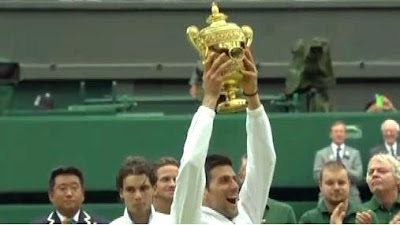
An inspired Novak Dkojovic defeated Rafael Nadal 6-4, 6-1, 1-6, 6-3 to claim his first Wimbledon title today.
===
It would be impossible to briefly sum up the monumental strides that Novak Djokovic has made, both as a tennis player and as a person, in the last 8 months. Still, we ought to try. And perhaps when we do try, each of us might find a way to glean a bit of magic from the man who has stormed the tennis world in dramatic fashion in 2011.
"What is it that's made you virtually unbeatable this year?" asked a genuinely curious John McEnroe, in a post-match interview with the newly-crowned Wimbledon champion today.
Djokovic smiled. He must have been thinking: 'Ah, where to start, and how to not sound too corny?' Then he spoke: "There's a small percentage of improvement in a couple of shots in my game," Djokovic began, "like serve for example, maybe a little bit better forehand coming to the net, good return."
Fair enough. There's no denying that everything Djokovic has done in 2011 has been better than ever, but deep down we all know that the man's torrid 2011 is about so much more than a small improvement in a few strokes. Yes, he's been striking the ball with gusto, opening up the court with ridiculous angles and moving like a gazelle. But still, there's something more, something intangible that Djokovic now possesses, and it's been playing a large role in all his recent success.
"There was no major changes," continued Djokovic, in response to McEnroe's question, and finally getting to the crux of the matter. "It's just I think that I matured mentally and I believe on the court that I can win against Nadal, Federer, Murray -- the big guys in the big tournaments -- and now it's really coming true."
And that is the essence of this magical spell for Djokovic: belief.
For Djokovic, it's not simply about hitting the ball -- he's always known how to do that -- or constructing points, or even his increased stamina. His resurgence has been fueled by something bigger, something all-encompassing. His journey to the top of tennis has been less about x's and o's (or gluten or the lack of gluten) than it has has been about resolve, stick-to-itiveness, conquering demons and overcoming hurdles.
Yes, Djokovic's rise to the top of men's tennis provides a perfect tactical guide for how to be a champion -- the technique is there, the flexibility too -- but none of the mind-blowing tennis that Djokovic produced today would have been possible without a certain spiritual alacrity.
Djokovic's greatest improvement, more than the flexibility that has led to his Cirque Du Soleil poses at the baseline or any of his newfound pop on the serve, has come from within. That big bloody beating device inside his chest, the one he pounds mercilessly while communing with his player's box during matches: the heart.
And from the heart comes belief. Djokovic had it throughout today's tense affair, even as he struggled with a determined Nadal, who started to find his groove in the third and fourth sets.
Surprisingly, if anyone lacked confidence in today's final, it was Nadal. "I was a little bit too nervous, probably at 5-4 in the first set," said the 10-time Grand Slam champion, "and probably 4-3 of the last set. At that moment the match was there -- I had chances to be there and to be playing the fifth right now."
Those moments of nervousness for Nadal were moments of inspiration for Djokovic.
Long rallies, normally the domain of Nadal, went to Djokovic on crucial points time and time again. Djokovic won 16 of 25 points that went 10 or more strokes, but more importantly, he won three consecutive long rallies to go from 0-30 down in the 10th game of the first set to holding set point.
He converted the set point, and from that point on it was his match to win or lose.
As Nadal mounted a serious charge in the third and fourth sets, Djokovic once again called upon his belief to get him over the finish line. He secured the decisive break in the fourth set after a 14-stroke rally, then used his first serve-and-volley play of the match at 30-all in the final game to secure a look at a match point.
He would only need one look. Nadal's backhand sailed long and the Serb fell to his back on the grass, celebrating the most coveted title in all of tennis.
The look on his face was priceless, but it was not a look of surprise. Djokovic is a man who knows he belongs at the top of tennis now.
Now that he's beaten Rafael Nadal five consecutive times on three different surfaces, and become the only man besides Federer to defeat the Spaniard in a Grand Slam final, that fact is pretty hard to deny.
Djokovic can look at the stats to get his confidence for the hardcourt season, or he can keep doing what he's been doing all year -- looking within for inspiration.
Either way he should be fine.
Saturday, July 2, 2011
Archie's Picks: Nadal-Djokovic
Archie believes that 2011 is the year of Nole, so he's picking Djokovic to get his fifth consecutive win over Nadal in the Wimbledon final tomorrow.

===
Well, here we go, the match to end all matches -- at least for a few days! No, seriously, as I mentioned in this post, this is the Grand Slam final that I've been waiting for since May, and Archie has too. Speaking of Archie, if you see that doggie biscuit perched on his nose in the picture above, you can get a feel for the kind of anticipation that has been built up for this match. He says he'd rather see Nadal play Djokovic in a Grand Slam final than eat that treat. And the dog don't lie.
If you've followed along with Archie through the men's quarters, you also know that he's a smart dog. He's gone 8 for 9 thus far, and if Nole continues doing what he's done for the last seven months, he'll be 9 for 10. Archie wants you all to know that win or lose, right or wrong, he's had a lot of fun sharing Wimbledon 2011 with you all. He say he'll talk to you all later in the summer when the US Open rolls around. Until then, he says you're on your own, because he doesn't do these piddly little Masters or Premier events (Take it easy, he said it with a smile.).
Without any further ado, here is Archie's Djokovic-Nadal pick.
See Archie's French Open picks here.
See Archie's Djokovic-Tomic pick here.
See Archie's Federer-Tsonga pick here.
See Archie's Nadal-Fish pick here.
See Archie's Murray-Lopez pick here.
See Archie's Kvitova-Azarenka pick here.
See Archie's Sharapova-Lisicki pick here.
See Archie's Djokovic-Tsonga pick here.
See Archie's Nadal-Murray Pick here.
See Archie's Sharapova-Kvitova pick here.
Archie's pick: Djokovic
Why: Because Nole is the type of guy that would befriend a dog like me, while Nadal would probably be told by his uncle that pit bulls are scary, and that I could injure him (so not true, imo).
My Pick: Nadal
Why: Does it get any bigger than this? Two absolute titans of the sport, in fine form, slugging it out for the most prestigious title in all of tennis. In one corner, Rafa, in search of his third Wimbledon-French double and 11th Grand Slam, and in the other the man who has single-handedly broken up the Federer-Nadal duopoly by the sheer force of his own desire (and brilliant play).
Djokovic has been the consummate professional throughout 2011, managing his schedule to a tee, playing world-class tennis every time he steps on the court, and conquering his health-related issues and inconsistencies with aplomb. Nadal, meanwhile, started the year with some lowlights, but eventually responded by running the table at the French Open for his sixth title.
So, then, how do we pick this?
I must admit, it's tough, but I've chosen Nadal based on the fact that his game has looked a tad more fine-tuned on the Wimbledon grass. Add to that the fact that I don't know how in the heck anybody can beat this man -- at this stage of his career -- five times in a row, and there you have my pick.
That being said, if Djokovic can do it four times in a row, than can't we assume that the man can pretty much do anything? You'd be right in saying that as well, and that is what makes this final so difficult to pick.
Enjoy the match, my friends, and don't let your rooting interests get in the way of your appreciation of the tennis, which will be played at the highest level, I'm sure.

Proving Time for Djokovic and Nadal
Novak Djokovic and Rafael Nadal will meet in a heavily anticipated Wimbledon final on Sunday. Get your popcorn ready.

===
The 2011 French Open, just four weeks ago, offered us many inspiring moments, but there was one thing it lacked: Rafael Nadal didn't get a chance to face his new arch nemesis, Novak Djokovic, in a battle to the death in the final. While I was thrilled for Federer when he engineered his magical run in Paris, part of me was devastated not to see what I had built up in my mind as the final to end all finals.
I couldn't stop drooling over it: The transcendent Djokovic, suddenly Nadal's kryptonite for four consecutive matches, playing with a chance to tie Guillermo Vilas for the longest men's winning streak of all-time; the hell-bent Nadal looking to claim his sixth French Open title, committed also to ending Djokovic's temporary reign over him.
It was sure to be an epic battle on many levels. You could feel the axis of tennis shifting, but you also knew in your heart that Nadal wasn't going to go down without an epic fight. Maybe he wouldn't go down at all. But it didn't seem out of the question anymore, thanks to Djokovic's stellar form.
Who would prevail? Nadal, the eminent clay court player, now subdued, doubting his game, or Djokovic, surfing the clouds, confident, committed, and possessing renewed faith and vigor?
Then Fabio Fognini withdrew from his French Open quarter-final, making it impossible for Djokovic to get his 46th win in the final. Next, Federer gave the Serb a whooping and the planet shifted back on its axis.
Is it ready to shift again?
Here we are at Wimbledon, and these two tennis titans are about to lock horns in their first Grand Slam final since all this Kryptonite talk began.
A lot has changed in the four weeks since the French -- Djokovic's streak went up in smoke and Nadal's fire is burning brightly again. The Spaniard didn't beat Djokovic in the final in Paris, but in Djokovic's loss to Federer he saw that he was human - he could lose. Since then Nadal's Wimbledon winning streak has grown to 20 matches, and he's been unrelenting throughout the fortnight.
Djokovic, while not as graceful on grass as he is on clay, appears ready for the challenge of Nadal nonetheless.
There is much to prove in this final for each, and the high stakes will certainly add to the intrigue. Nadal can win his third French-Wimbledon double (tying Borg) and his 11th Grand Slam (tying Laver and Borg). Djokovic can bag his most coveted title at Wimbledon and put a fat stamp of approval on his fresh No. 1 ranking.
However it turns out, tennis fans should be pleased. In 2011, Djokovic and Nadal is the meal and all other matches are the appetizer.
Thursday, June 30, 2011
Archie's Picks: Murray-Nadal
Does Andy Murray have a chance tomorrow? Heck yeah. Will he win? Heck no, says Archie.

===
Okay, big stuff going on tomorrow. Archie made his pick earlier today with a stoic, almost cold shrewdness. Why? He was hurt. Deep down he wants the underdog to have his day, and he thinks Murray deserves that much. But in an even deeper place, he knows that the pit bull that lives in Rafa's chest will squelch all the British fun.
He's torn, to say the least. Not about who's going to win, but who he wants to win.
See Archie's French Open picks here.
See Archie's Djokovic-Tomic pick here.
See Archie's Federer-Tsonga pick here.
See Archie's Nadal-Fish pick here.
See Archie's Kvitova-Azarenka pick here.
See Archie's Sharapova-Lisicki pick here.
See Archie's Djokovic-Tsonga pick here.
Archie's Pick: Nadal
Why: Duh
My Pick: Nadal
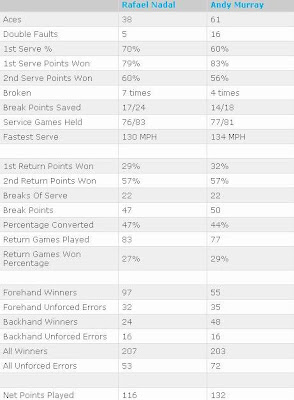
Why: Normally I wouldn't think it was too far fetched to pick Murray for the stunner tomorrow, but have you guys seen Nadal play lately? He's so good on the Wimbledon grass, it's like he's still on clay. And his forehand has been an even bigger weapon that it usually is on clay. Murray is no slouch either -- far from it -- and he's scored a couple of confidence building wins at Slams vs. Nadal (2009 US Open semi and 2010 Australian Open quarters) in recent years, but the same questions persist: Can he come good in a match of epic proportions against a player of epic stature? Someday it's going to happen, but until he's erased those doubts, it's hard to go out on a limb and pick him to win a match like this.
So there you have it. Go ahead and prove me wrong Mr. Murray -- I dare you.
Subscribe to:
Posts (Atom)